


Cyber threat intelligence becomes significantly more valuable when it can move beyond isolated platforms and be securely exchanged between organisations, analysts, and security ecosystems. Byron Labs has reached an agreement with SC-DIXAE (Smart Cities Data Intelligence eXchange for Advanced Ecosystems) to provide cyber threat intelligence generated by Vysion through an automated MISP-compatible feed.
As part of this initiative, Byron Labs is collaborating with SC-DIXAE to provide cyber threat intelligence collected and processed by Vysion through its API, using a MISP-compatible feed designed for automated integration and information sharing. The collaboration connects Vysion's external threat visibility with SC-DIXAE's interoperable data ecosystem, making cyber intelligence easier to consume, correlate, and reuse across different security environments.
Ransomware intelligence through Vysion
Vysion monitors external sources used by threat actors, including ransomware leak sites. This monitoring allows the platform to identify organisations published as victims by ransomware groups and structure the information so that it can be searched, analysed, and integrated into other security systems.
The integration creates a simple automated flow: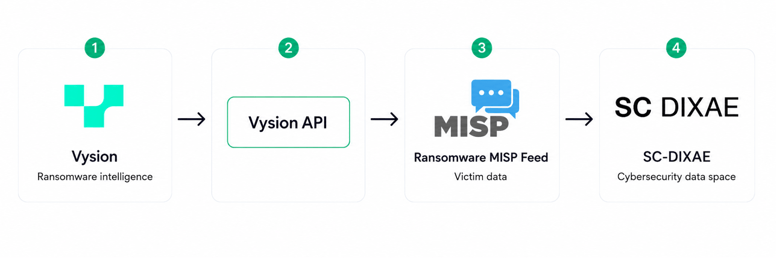 Instead of manual exports, new ransomware victim information collected by Vysion can be consumed programmatically. Using MISP also means that the intelligence can be incorporated into an existing CTI workflow and correlated with information coming from other sources within the data space.
Making threat intelligence easier to integrate
Cyber Threat Intelligence is not only about collecting information, but it is also important to make it available in a format that other platforms and organisations can actually ingest and use.
Vysion was designed with this in mind. Alongside the platform itself, its API and integrations allow intelligence to be incorporated into external workflows without requiring analysts to manually move information between tools.
In the case of SC-DIXAE, the MISP feed provides a standardised way of sharing ransomware victim data while preserving the structure needed for subsequent analysis and correlation. The collaboration with SC-DIXAE is therefore a practical example of how Vysion can operate not only as a cyber intelligence platform, but also as a source of structured threat intelligence for external systems.
For Byron Labs, this is an important part of how we approach CTI: collecting information is only one part of the process. The intelligence also needs to be accessible, interoperable and easy to integrate into the tools and environments where it can provide value.